
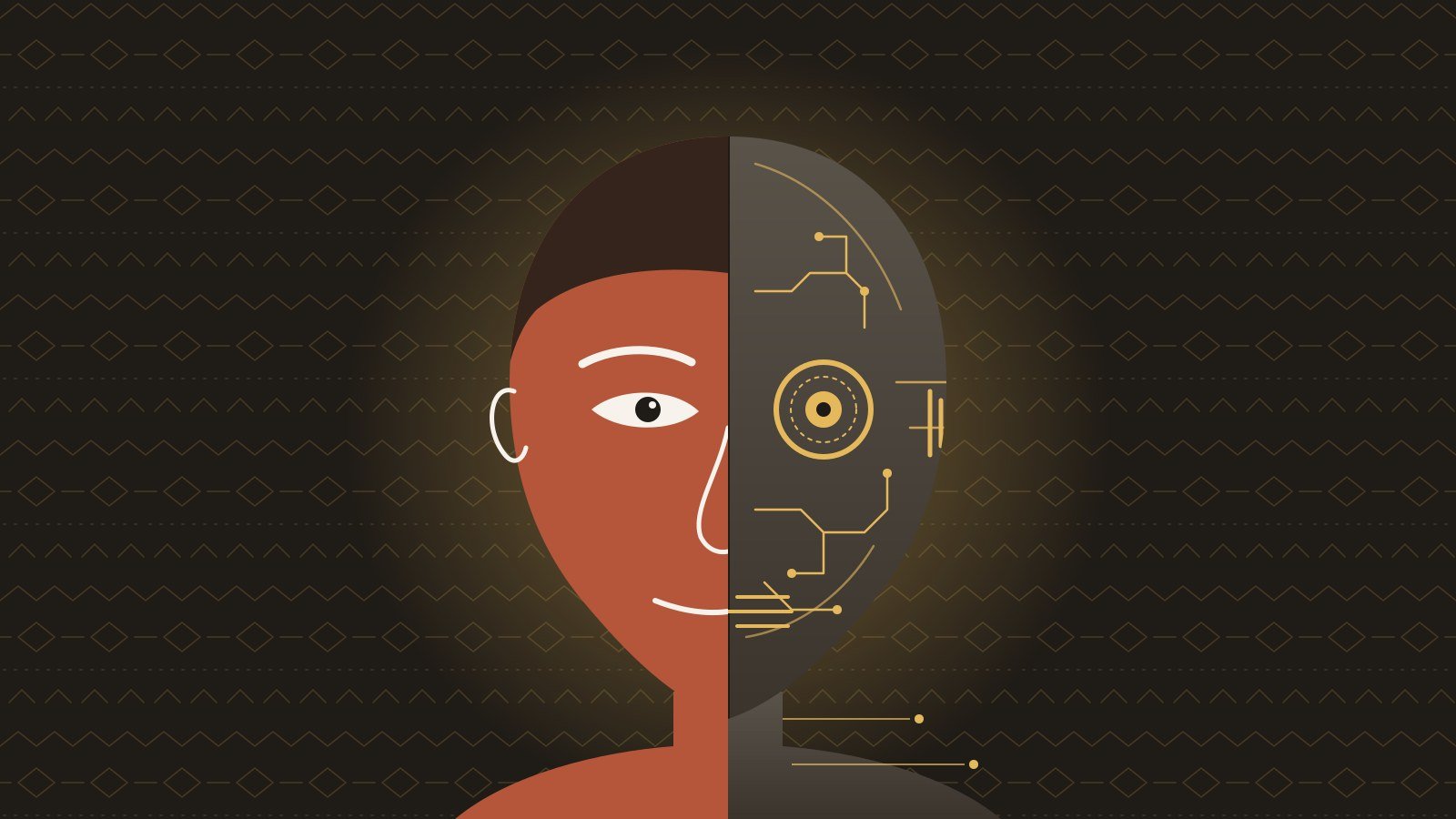
Throughout history, the Church has wrestled with various forms of new innovations. From the invention of the printing press, which changed how information spreads and broke barriers to accessing truth, to the Industrial Revolution, which reshaped human understanding of labor and purpose, and even the Copernican finding, which redefined humanity’s place in the universe. Each moment of change has raised the question of what it means to be human, one created in the image of God, and what it means to live, create, and flourish as individuals and communities. Today, we face a similar season in our human progression, as Artificial Intelligence (AI) emerges as one of the most pivotal technological advancements in modern history, fundamentally changing the ways we interact as humans with machines, each other, and the world around us.
Artificial intelligence now sits in the study, the pulpit, and the pocket. It drafts memos and sermons, sketches images, tutors our children, and increasingly proposes and produces creative options in music, writing, and design. What does it mean, then, to bear God’s image and express human creativity in the age of algorithms? As Braden Molhoek notes, the emergence of artificial intelligence challenges theology to reconsider the scope of human creative action and what it means to be “created co-creators” with God, whose image we bear through both dependence and participation in divine creativity (Molhoek 2022).
I argue that Christian creativity, shaped by the image of God, should use artificial intelligence wisely, as a tool that helps people flourish, but never in a way that replaces human responsibility or imagination. Christians are called to remain co-creators, and not to surrender what it means to be creative beings to machines.
Clarifying Terms: AI, Creativity, and Imago Dei
Artificial intelligence, in this context, refers to specialized systems designed to perform specific tasks. These include large language models and diffusion models that generate text, images, audio, or code by recognizing and replicating patterns from vast datasets. Such systems operate on probabilities rather than understanding. They predict likely outcomes based on data rather than true reasoning or insight. While they can produce original and useful results, they can also generate false or misleading information. Despite their sophistication, these systems do not possess subjective experience, moral awareness, or embodied consciousness (Lumbreras 2022; Graves 2022).
Creativity can be understood as the act of producing something both original and valuable within a community that recognizes its worth. Margaret Boden identifies three main types of creativity. The first two, combinational and exploratory creativity, involve combining existing ideas or exploring known possibilities, areas in which artificial intelligence tends to perform well. The third, transformational creativity, goes further by changing the very framework of what is possible, something current AI systems rarely achieve (Boden 2004). Dorothy Sayers offers a theological dimension to this understanding. To create is to reflect the nature of the Creator (Sayers 1941). In this sense, creativity is not only a technical skill but an expression of vocation and agency, an act that mirrors divine purpose and extends the creative nature of God. To be human, in this sense, is to create.
The theologian Philip Hefner explains that the Imago Dei, the image of God, can be understood in three complementary ways. The substantive view sees the image in human qualities such as reason, imagination, and creativity. The functional view understands it as the calling of humanity to act as stewards, exercising responsible care and dominion over creation. The relational view highlights the human capacity for relationship with God, with others, and with the world around us. Hefner brings these perspectives together with his phrase “created co-creators,” describing humans as partners in God’s ongoing creative work, participants who contribute meaningfully but never replace the Creator (Hefner 1993). Jürgen Moltmann expanded on this idea by emphasizing that bearing God’s image means living in relationship, reflecting the love and interdependence of the Trinity (Moltmann 1993). In the same way, Karl Barth teaches that the Imago Dei is most clearly revealed in our relationships with one another, where mutual love and responsibility mirror God’s own fellowship (Barth 1960). Together, these theologians remind us that being made in God’s image is not only a status we possess but a vocation to live creatively, responsibly, and in communion with others.
Theological Foundations: The Imago Dei and Human Creativity
The concept of Imago Dei stands at the core of Christian teaching, and it offers a theological framework to navigate modern technological realities and challenges. Hefner’s notion of human beings as “created co-creators” captures the paradox of divine dependence and human participation (Hefner 1993). Human creativity, in this way, is not autonomous innovation but one born out of a relational collaboration with the Creator. As Mark Graves emphasizes, theological anthropology views creativity not merely as cognitive skill but as moral vocation oriented toward communion and flourishing (Graves 2025). Therefore, the act of creating, whether it be a sermon, a song, or an algorithm, carries ethical and spiritual significance.
Young Choi highlights that, for Christians, technological creativity should be an expression of stewardship and service rather than dominance (Choi 2024). The human capacity to innovate is an extension of divine generosity, and it must stay anchored to the Creator who puts it in motion. We reflect God not just in what we make but in how we love, steward, and relate through our creative acts. In this theological light, AI becomes neither idol nor enemy but a tool within God’s broader gifts of creation. After all, AI itself is a part of human creativity, thus part of God’s created order. As Lumbreras argues, the human vocation is not to compete with machines for intelligence but to embody wisdom, the integration of knowledge and virtue that no algorithm can replicate (Lumbreras 2022).
Steven Umbrello’s analysis of the Vatican’s AI guidelines emphasizes that technology, as a product of human creativity, is a divine gift that must be ordered toward human dignity and the common good (Umbrello 2025). AI, if unchecked, risks reinforcing biases, manipulating uncritical thinking, or eroding autonomy, the very qualities that express the image of God. Ahmed, Sumi, and Aziz similarly warn that over-reliance on AI can equalize creativity but also diminish diversity, flattening the unique expressions of human imagination (Ahmed, Sumi, and Aziz 2025). For theology, this raises profound questions about authorship, authenticity, and relationality: can a generated poem or painting bear witness to divine beauty without the breath of human intention?
Christian Practice: Creativity as Stewardship
In Christian practice, creativity is not a quest for originality but a participation in God’s motive in creating and through creation. Mark Graves invites us, as humans and as moral agents, to ensure that creative technologies foster justice and community instead of exploitation (Graves 2022). Umbrello’s Vatican framework provides four principles for responsible AI: dignity, transparency, stewardship, and the common good, that should guide AI’s integration in ministry and art (Umbrello 2025). For example, pastors who use generative tools for sermon illustrations can disclose AI assistance as a form of ethical transparency, maintaining trust within the body of Christ. Artists who incorporate AI into sacred art can emphasize co-creation, making visible the relationship of human imagination and divine inspiration.
For Christian practice, AI becomes a setting for creative stewardship rather than a substitute for human vocation. Platovnjak and Svetelj argue that AI “already [influences] nearly every aspect of our lives,” yet it also “calls for wisdom, hope, and belief that transcends sophisticated knowledge produced by AI,” inviting the Church to “rediscover the essence of human nature that AI technology cannot adequately grasp” (Platovnjak and Svetelj 2024). Practically, this means using AI to extend human creativity, composing, designing, and teaching, while keeping agency, accountability, and care at the center. Stewardship, then, is not ceding decisions to AI systems but exercising responsible dominion that elevates persons, protects the vulnerable, and orients technological power toward communion with God and neighbor (Platovnjak and Svetelj 2024).
Conclusion
Artificial intelligence challenges the Church toward a theological articulation of what makes us uniquely human in an era of the artificial. It also provides an opportunity to reimagine creativity as covenantal partnership rather than competition. Christians, as bearers of the divine image, are called to shape AI with humility, hope, and responsibility, harnessing it to heal divisions, tell better stories, and extend the reach of compassion. The Imago Dei reminds us that our creative power is embodied, relational, and accountable to love and the greater good for human flourishing. In this light, human creativity will continue to reflect God’s glory, not by transcending our limits, but by revealing God’s image even through the tools we build.
References
Ahmed, Saif, Ayesha Akter Sumi, and Norzalita Abd Aziz. 2025. “Exploring Multi-Religious Perspective of Artificial Intelligence.” Theology and Science 23 (1): 104–128.
Barth, Karl. 1960. Church Dogmatics III/2: The Doctrine of Creation. Translated by G. W. Bromiley and T. F. Torrance. Edinburgh: T&T Clark.
Boden, Margaret A. 2004. The Creative Mind: Myths and Mechanisms. 2nd ed. London: Routledge.
Choi, Young. 2024. “The Intersection of Artificial Intelligence and Christian Thought: A Vision for the Future.” Center for Christian Thought & Action, Regent University, October 8, 2024. ccta.regent.edu.
Graves, Mark. 2022. “Theological Foundations for Moral Artificial Intelligence.” Journal of Moral Theology 11 (Special Issue 1): 182–211.
Graves, Mark. 2025. “Theological Frontiers for AI Creativity.” AI & Faith, June 6, 2025. aiandfaith.org.
Hefner, Philip. 1993. The Human Factor: Evolution, Culture, and Religion. Minneapolis: Fortress Press.
Lumbreras, Sara. 2022. “Lessons from the Quest for Artificial Consciousness: The Emergence Criterion, Insight-Oriented AI, and Imago Dei.” Zygon: Journal of Religion and Science 57 (3): 647–662. https://doi.org/10.1111/zygo.12827.
Molhoek, Braden. 2022. “The Scope of Human Creative Action: Created Co-Creators, Imago Dei and Artificial General Intelligence.” HTS Teologiese Studies / Theological Studies 78 (2).
Moltmann, Jürgen. 1993. God in Creation: An Ecological Doctrine of Creation. Minneapolis: Fortress Press.
Platovnjak, Ivan, and Tone Svetelj. 2024. “Artificial Intelligence and Imago Dei: A New Dilemma for Philosophical and Theological Anthropology.” Bogoslovni Vestnik / Theological Quarterly 84 (4): 835–846. https://doi.org/10.34291/BV2024/04/Platovnjak.
Sayers, Dorothy L. 1941. The Mind of the Maker. London: Faber & Faber.
Umbrello, Steven. 2025. “Lessons from the Vatican’s AI Guidelines.” Word on Fire, February 6, 2025. wordonfire.org.

Leave a Reply